Estimated Reading Time: 12 – 15 Minutes
Executive Summary
Corporate Tax in Oman is a direct tax imposed on the taxable income of eligible businesses operating in the Sultanate. Businesses that fall within the applicable regulations are required to maintain accurate accounting records, determine their taxable income, and comply with the filing and reporting requirements of the Oman Tax Authority.
While corporate tax is a legal compliance requirement, it is also an important part of good financial management. Businesses with organised bookkeeping, reliable financial records, and a clear understanding of their obligations are generally better prepared to meet compliance requirements while making informed business decisions.
This guide explains what Corporate Tax is, who it applies to, how the system works, and the practical steps businesses can take to remain compliant.
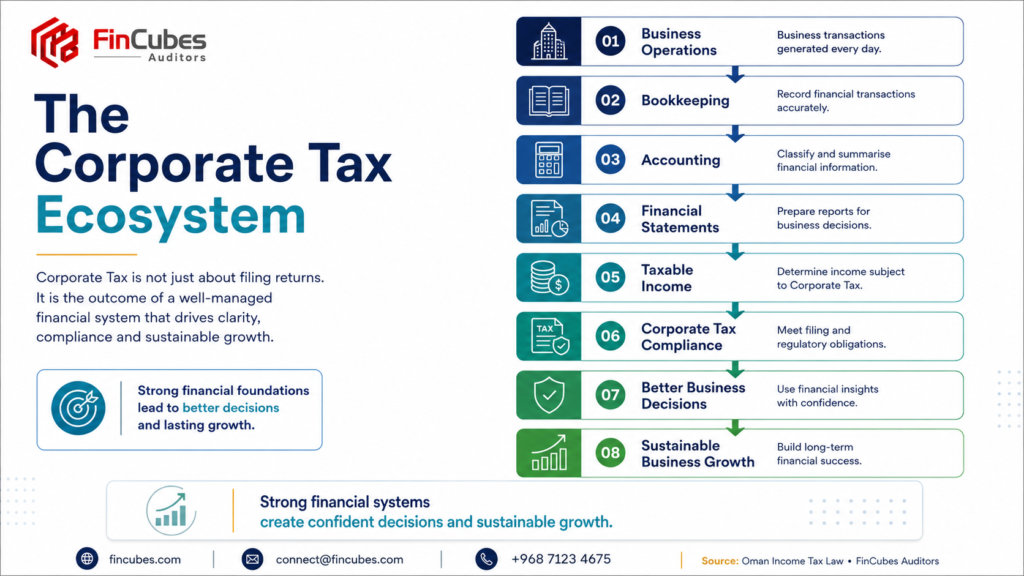
At a Glance
| Topic | Summary |
| Applicable To | Eligible businesses operating in Oman |
| Administered By | Oman Tax Authority |
| Based On | Taxable income (not revenue or turnover) |
| Key Requirements | Registration, maintain accurate accounting records, prepare financial statement, determine tax liability, tax return filing and ongoing compliance |
Corporate Tax in Oman: Why Every Business Owner Should Understand It
Running a successful business involves more than generating sales and managing day-to-day operations. Every business also has financial and regulatory responsibilities that support long-term stability and sustainable growth. Corporate Tax is one of those responsibilities.
Many business owners first think about tax only when a filing deadline approaches. By then, they may be searching for invoices, reconciling incomplete accounts, or trying to reconstruct months of financial records. This reactive approach often creates unnecessary pressure and increases the risk of errors.
A more effective approach is to view Corporate Tax as part of an organised financial management process rather than a year-end obligation. Businesses that maintain accurate bookkeeping, regularly review their financial performance, and keep supporting documents in order are generally much better prepared when it is time to meet their tax obligations.
Whether you operate a trading company, construction business, consultancy, manufacturing unit, or another type of enterprise in Oman, understanding how Corporate Tax works enables you to:
- Make better-informed financial decisions.
- Reduce compliance risks.
- Maintain accurate financial records throughout the year.
- Prepare confidently for tax filing requirements.
- Support sustainable business growth.
This guide has been created specifically for business owners, directors, finance managers, and entrepreneurs who want a practical understanding of Corporate Tax in Oman. Rather than focusing solely on legislation, it explains what the regulations mean in day-to-day business operations and how businesses can prepare effectively.
💡 FinCubes Auditors Insight
Businesses that approach Corporate Tax as an ongoing financial management process not simply an annual filing exercise are usually better positioned to maintain compliance, improve reporting accuracy, and make stronger business decisions throughout the year.
Understanding Corporate Tax in Oman
Before looking at registration requirements, tax rates, or filing obligations, it’s important to understand what Corporate Tax actually is and why it matters to businesses operating in Oman.
Many business owners assume Corporate Tax is simply another government fee. In reality, it is a direct tax on the taxable income earned by eligible businesses. It forms part of Oman’s broader taxation framework and is administered by the Oman Tax Authority in accordance with the country’s Income Tax Law.
Unlike VAT, which is collected on the sale of goods and services, Corporate Tax is based on a company’s taxable profits after considering the applicable provisions of the tax law. This means that revenue, profit, and taxable income are not the same thing, and understanding the difference is essential for accurate tax compliance.
Why Does Oman Have Corporate Tax?
Like many countries around the world, Oman uses Corporate Tax as part of its public revenue system. The tax contributes to funding public services, infrastructure, and long-term economic development while supporting the country’s broader fiscal sustainability objectives.
For businesses, Corporate Tax also encourages stronger financial governance. Companies are expected to maintain reliable accounting records, prepare financial statements, and report their taxable income accurately. These practices not only support compliance but also improve financial transparency and business decision-making.
What Does Corporate Tax Mean for Your Business?
For many SMEs, Corporate Tax is often viewed as a once-a-year obligation. In practice, compliance starts much earlier.
A business that maintains accurate bookkeeping throughout the year is generally in a much stronger position to:
- Prepare reliable financial statements.
- Calculate taxable income accurately.
- Respond to requests for supporting documentation.
- Meet filing deadlines with confidence.
- Reduce the likelihood of costly errors or last-minute corrections.
On the other hand, businesses that postpone their accounting until the end of the financial year often spend significant time reconstructing records, reconciling transactions, and locating missing documents. This can make the tax filing process more complex than it needs to be.
💡 FinCubes Auditors Insight
Corporate Tax compliance is not built during the week before a tax return is due. It is built through consistent bookkeeping, organised financial records, and regular financial reviews throughout the year. Businesses that invest in good financial discipline are generally better prepared for compliance and better equipped to make informed business decisions.
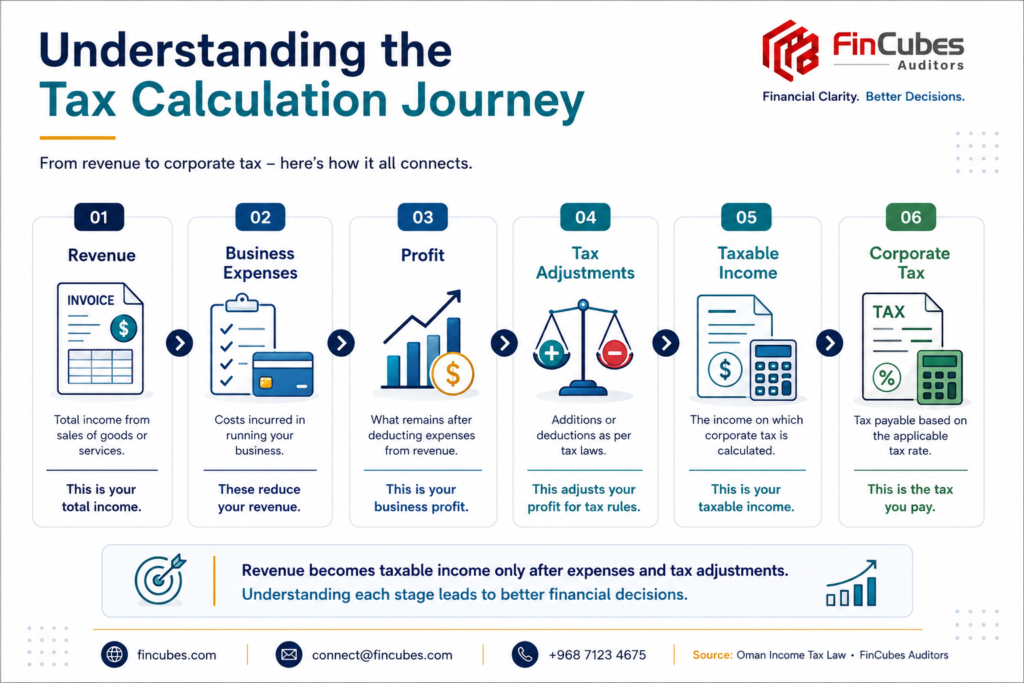
Corporate Tax vs Revenue vs Profit
One of the most common misconceptions among business owners is assuming that Corporate Tax is calculated on total sales or turnover.
These are three different concepts:
| Term | Meaning |
| Revenue | The total income generated from selling goods or providing services before expenses are deducted. |
| Profit | The amount remaining after deducting business expenses from revenue. |
| Taxable Income | The amount on which Corporate Tax is calculated after applying the relevant provisions of Oman’s Income Tax Law. |
Understanding this distinction helps business owners interpret financial reports more accurately and avoid confusion when planning for tax obligations.
Why Accurate Accounting Matters
Corporate Tax is only one part of a business’s financial responsibilities. The quality of your accounting records influences almost every stage of the compliance process.
Accurate bookkeeping helps businesses:
- Track income and expenses correctly.
- Produce reliable financial statements.
- Support tax calculations with appropriate documentation.
- Identify discrepancies before they become compliance issues.
- Make informed strategic and financial decisions throughout the year.
Rather than viewing bookkeeping as an administrative task, businesses should see it as the financial foundation that supports Corporate Tax compliance, financial reporting, budgeting, and long-term growth.
Quick Business Checklist
Before thinking about Corporate Tax filing, ask yourself:
- ✓ Are invoices, receipts and supporting documents well organized?
- ✓ Can I calculate my taxable income accurately?
- ✓ Are we aware of the Corporate Tax filing and payment deadlines?
- ✓ Do we review the financial records regularly throughout the year?
- ✓ Are your business expenses properly documented?
- ✓ Can you produce accurate financial statements when required?
- ✓ Are invoices and supporting documents organised?
- ✓ Do you know your company’s financial year-end?
If you answered “No” to any of these questions, improving your financial record-keeping should be one of your first priorities before focusing on tax compliance.
Does Corporate Tax Apply to Your Business?
One of the first questions every business owner ask is:
“Do these Corporate Tax rules actually apply to my business?”
The answer depends on several factors, including the legal structure of your business, where it operates, the nature of its activities, and the applicable provisions of Oman’s Income Tax Law.
Rather than assuming Corporate Tax either applies to everyone or to only large companies, it’s important to understand how the rules relate to different types of businesses.
The following overview provides a general understanding. Every business should assess its specific circumstances before determining its tax obligations.
Omani Companies
Companies established and operating in Oman are generally required to understand and comply with the applicable Corporate Tax regulations.
This includes maintaining proper accounting records, preparing financial statements, and meeting any registration and filing obligations that apply to their business.
The exact tax treatment depends on the applicable legal provisions, taxable income, and other relevant factors.
Foreign Companies Operating in Oman
Foreign businesses conducting activities in Oman may also have Corporate Tax obligations, depending on the nature of their operations and whether they establish a taxable presence within the Sultanate.
Businesses expanding into Oman should evaluate their tax position early to avoid unexpected compliance issues as operations grow.
Small and Medium Enterprises (SMEs)
Many SME owners assume Corporate Tax is relevant only to large corporations.
In reality, SMEs should understand the regulations that apply to their business and maintain accurate financial records regardless of their size.
Even where a business may qualify for specific tax treatment or exemptions, proper bookkeeping and financial documentation remain essential.
📌 Business Owner Note
Good bookkeeping isn’t just about preparing for tax returns. It helps business owners understand profitability, improve cash flow management, and make informed business decisions throughout the year.
Businesses That May Qualify for Different Tax Treatment
Not every business is taxed in exactly the same way.
Depending on the applicable legislation, some businesses or organisations may qualify for different tax treatment, exemptions, or specific provisions.
Because eligibility depends on individual circumstances, businesses should avoid making assumptions based on information from other companies or industries.
Where there is uncertainty, professional advice can help clarify the correct treatment.
Why Understanding Your Business Status Matters
Knowing whether and how Corporate Tax applies to your business is only the first step.
Understanding your obligations early allows you to:
- Maintain the right accounting records from the beginning.
- Prepare accurate financial statements.
- Plan for future tax compliance.
- Reduce the risk of errors or missed obligations.
- Make better-informed financial decisions as your business grows.
Businesses that wait until a filing deadline to understand their obligations often face unnecessary stress and additional administrative work.
💡 FinCubes Auditors Insight
One of the most common misconceptions we encounter is that Corporate Tax becomes relevant only when it’s time to file a return. In reality, businesses should understand their tax position much earlier. Decisions made throughout the financial year such as how transactions are recorded, expenses are documented, and financial records are maintained can significantly influence the efficiency and accuracy of the compliance process.
✅ Business Readiness Checklist
Before moving to the next section, ask yourself:
- □ Do I understand whether Corporate Tax applies to my business?
- □ Is my accounting records maintained throughout the year?
- □ Can I produce reliable financial statements if required?
- □ Do I know which documents should be retained for tax purposes?
- □ Have I reviewed my business’s compliance obligations?
If you’re uncertain about any of these questions, it’s a good idea to review your financial processes before your next compliance deadline.
Understanding Corporate Tax Rates in Oman
What Is the Corporate Tax Rate in Oman?
One of the most common questions business owners ask is:
“What is the Corporate Tax rate in Oman?”
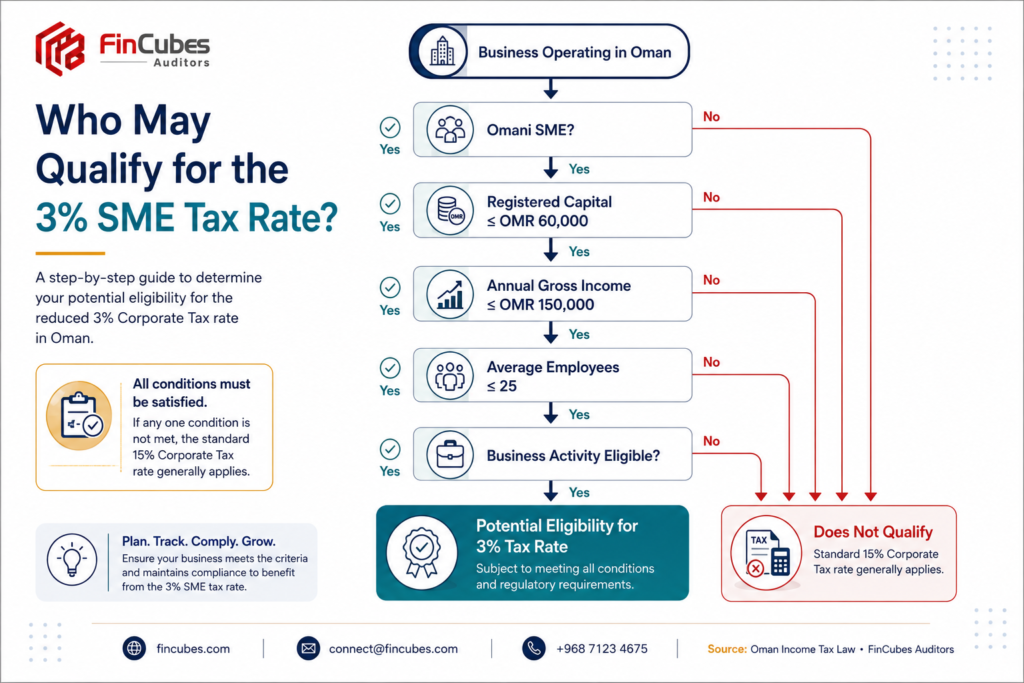
For most businesses, the standard Corporate Income Tax rate is 15% of taxable income. However, the amount of tax a business pays depends on its taxable income not its total sales or revenue. Certain qualifying Omani SMEs may be eligible for a reduced 3% tax rate if they satisfy the conditions prescribed under Oman’s Income Tax Law.
Understanding this distinction is important because many businesses mistakenly assume that tax is calculated on total turnover.
Taxable Income Is Not the Same as Revenue
A common misconception is that Corporate Tax is charged on everything a business earns.
In practice, there are three different financial measures that every business owner should understand.
| Financial Term | What It Means |
| Revenue | Total income generated from sales before deducting expenses. |
| Profit | The amount remaining after business expenses have been deducted from revenue. |
| Taxable Income | The amount determined under Oman’s Income Tax Law on which Corporate Tax is calculated. |
Understanding these differences helps business owners interpret their financial reports correctly and avoid confusion during tax planning.
Do All Businesses Pay the Same Rate?
Not necessarily.
While the standard Corporate Tax rate is 15% of taxable income, some qualifying Omani SMEs may be eligible for a reduced 3% tax rate. However, this reduced rate is available only to businesses that satisfy all of the eligibility conditions prescribed under Oman’s Income Tax Law.
Generally, a business must meet conditions relating to:
| Eligibility Criterion | Requirement* |
| Registered Capital | Does not exceed OMR 60,000 |
| Annual Gross Income | Does not exceed OMR 150,000 |
| Average Number of Employees | Does not exceed 25 employees |
| Nature of Business | Must not be an excluded professional or specified business activity |
*Businesses must satisfy all applicable conditions. Certain sectors and activities are excluded from the reduced SME tax rate under the Income Tax Law and related regulations. Eligibility should always be assessed based on the latest guidance issued by the Oman Tax Authority.
Because eligibility depends on meeting all applicable conditions, businesses should assess their circumstances carefully rather than assuming they automatically qualify. Where there is any uncertainty, seeking professional advice before relying on the reduced tax rate is advisable.
📌 Business Owner Note
Qualifying for the 3% SME tax rate does not remove the obligation to maintain proper bookkeeping, prepare financial records, and meet all applicable registration and filing requirements. Good financial management remains essential regardless of the applicable tax rate.
Why Accurate Financial Records Matter
Knowing the applicable tax rate is only one part of Corporate Tax compliance.
Before a business can calculate its tax liability, it must first determine its taxable income accurately. This depends on reliable accounting records, properly documented transactions, and financial statements prepared in accordance with applicable requirements.
Businesses with incomplete or inaccurate accounting records often face unnecessary challenges when preparing tax returns, responding to information requests, or reviewing their financial performance.
Good bookkeeping therefore supports much more than tax compliance. It also improves budgeting, cash flow management, financial reporting, and strategic decision-making.
💡 FinCubes Auditors Insight
Many business owners focus on “What tax rate will I pay?”
A better question is: “Are my financial records accurate enough to calculate my taxable income correctly?”
The tax rate is defined by law. The quality of the information used to calculate taxable income depends on how well a business manages its accounting throughout the year.
📊 Example
Imagine two businesses each generate OMR 500,000 in annual revenue.
Business A
- Maintains monthly bookkeeping.
- Reconciles bank accounts regularly.
- Keeps invoices and supporting documents organised.
- Prepares financial statements throughout the year.
Business B
- Updates accounts only at year-end.
- Has missing expense records.
- Cannot easily reconcile transactions.
- Spends weeks reconstructing financial information.
Although both businesses have the same revenue, Business A is generally far better positioned to determine its taxable income accurately and complete its Corporate Tax compliance efficiently.
Registering for Corporate Tax in Oman
Understanding Corporate Tax is only the first step. Businesses that are required to comply must also complete the registration process with the Oman Tax Authority and ensure that their records are maintained correctly from the beginning.
Many businesses delay registration because they believe it can be completed just before filing a tax return. In reality, understanding your registration obligations early helps avoid unnecessary compliance issues and allows you to prepare your financial records in a structured manner.
Registration should not be viewed as an isolated administrative task. It is the starting point of your business’s ongoing Corporate Tax compliance journey.
Who Should Register?
Businesses that fall within the scope of Oman’s Corporate Tax regulations should register in accordance with the applicable requirements issued by the Oman Tax Authority.
Whether registration is required depends on the legal status of the business and the applicable provisions of the Income Tax Law.
If you are unsure whether your business is required to register, it is advisable to review your circumstances early rather than waiting until a compliance deadline approaches.
📌 Business Owner Note
Waiting until the last minute to determine your registration obligations often results in unnecessary pressure and rushed financial preparation. Early planning provides more time to organise records and address any issues before filing becomes due.
Information Commonly Required During Registration
Although the exact requirements may vary depending on the nature of the business, companies should generally be prepared with information such as:
- Company registration details.
- Commercial Registration (CR) information.
- Tax Identification Number (where applicable).
- Details of shareholders or authorised representatives.
- Financial year information.
- Contact details and authorised signatories.
- Supporting business documentation requested by the Oman Tax Authority.
Having this information organised before beginning the registration process makes the experience significantly smoother.
Why Good Bookkeeping Should Begin Before Registration
One mistake some businesses make is assuming that bookkeeping becomes important only after they complete their Corporate Tax registration.
In reality, the quality of your accounting records before and after registration has a direct impact on future compliance.
Businesses that maintain organised financial records from the beginning are generally better prepared to:
- Produce accurate financial statements.
- Calculate taxable income.
- Support tax calculations with appropriate documentation.
- Respond efficiently to regulatory requests.
- Complete future tax filings with confidence.
Corporate Tax compliance is built on financial discipline not paperwork alone.
💡 FinCubes Auditors Insight
Registration is a milestone, not the finish line. Many businesses focus heavily on completing the registration process but invest far less attention in maintaining accurate accounting records afterwards. In practice, ongoing bookkeeping and regular financial reviews are what make future compliance straightforward.
Common Registration Mistakes
Businesses often create avoidable difficulties by:
- Waiting until deadlines are close before reviewing their obligations.
- Registering without ensuring their accounting records are up to date.
- Keeping incomplete financial documentation.
- Assuming another business’s tax position applies to them.
- Treating Corporate Tax as a once-a-year exercise instead of an ongoing compliance process.
Most of these challenges can be avoided through early planning and consistent financial management.
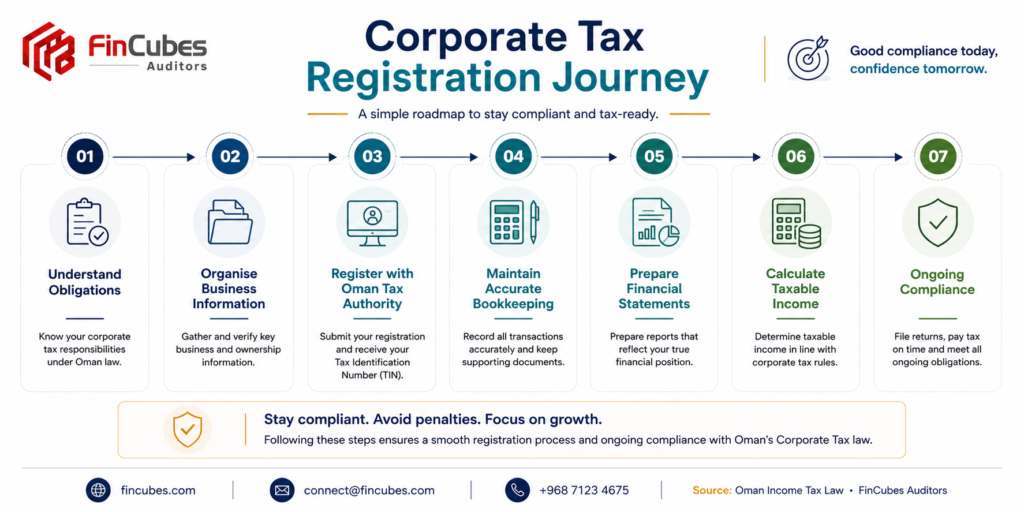
📊 Registration Journey
| Stage | What Your Business Should Do |
| 1. Understand Your Obligations | Review whether Corporate Tax applies to your business. |
| 2. Organise Business Information | Gather company registration details, financial year information, and supporting documents. |
| 3. Maintain Accurate Records | Ensure bookkeeping is current before registration. |
| 4. Complete Registration | Register through the Oman Tax Authority as required. |
| 5. Continue Compliance | Maintain records and prepare for future filing obligations. |
✅ Registration Readiness Checklist
Before beginning your Corporate Tax registration, confirm that you have:
- □ Reviewed whether your business is required to register.
- □ Organised your company registration details.
- □ Confirmed your financial year.
- □ Updated your bookkeeping records.
- □ Gathered supporting business documents.
- □ Identified the person responsible for tax compliance within your organisation.
Being prepared before registration can save considerable time and reduce the likelihood of issues later in the compliance process.
Corporate Tax Compliance and Filing Requirements
Registering for Corporate Tax is only the beginning of the compliance journey. Once a business is registered, it has an ongoing responsibility to maintain accurate financial records, prepare supporting documentation, and meet the filing obligations prescribed by the Oman Tax Authority.
Many businesses assume that compliance begins a few weeks before the filing deadline. In reality, successful compliance is the result of good financial management throughout the year.
Businesses that maintain organised accounting records generally spend less time preparing tax returns and are better positioned to respond to information requests when required.
Corporate Tax Compliance Is a Year-Round Responsibility
Corporate Tax should not be viewed as a single annual task.
Every financial transaction recorded during the year contributes to the information that will eventually be used to prepare financial statements and determine taxable income.
This means that bookkeeping, expense tracking, invoice management, and financial reconciliation are all part of Corporate Tax compliance not just the final tax return.
Businesses that maintain these processes consistently often experience a smoother compliance process and gain greater visibility into their financial performance.
Maintaining Proper Accounting Records
Accurate accounting records form the foundation of Corporate Tax compliance.
Businesses should maintain records that clearly reflect:
- Business income.
- Operating expenses.
- Asset purchases and disposals.
- Payroll and employee-related costs.
- Bank transactions.
- Supporting invoices and receipts.
- Contracts and other relevant financial documentation.
Well-maintained records make it easier to prepare financial statements, calculate taxable income accurately, and support information reported in tax returns.
Preparing Financial Statements
Financial statements are more than a reporting requirement, they provide the financial picture of a business.
Reliable financial statements help business owners:
- Understand business performance.
- Monitor profitability.
- Identify financial trends.
- Support budgeting and forecasting.
- Prepare Corporate Tax calculations with greater confidence.
Businesses that prepare financial statements regularly are generally better equipped to meet compliance requirements than those that prepare accounts only when deadlines approach.
Supporting Documentation Matters
Every figure reported in a tax return should be supported by appropriate business records.
Examples include:
- Sales invoices.
- Purchase invoices.
- Bank statements.
- Payroll records.
- Contracts.
- Payment confirmations.
- Expense documentation.
Maintaining organised supporting documentation reduces the likelihood of errors and makes responding to future queries significantly easier.
💡 FinCubes Auditors Insight
One of the biggest misconceptions among growing businesses is that Corporate Tax compliance is primarily about submitting a return. In practice, filing a return is often the easiest part. The real work happens throughout the year, maintaining accurate books, reconciling transactions, reviewing financial information, and ensuring that every figure reported can be supported with appropriate documentation. Businesses that develop these habits usually find compliance far less stressful.
The Role of Technology in Compliance
Modern accounting software can make Corporate Tax compliance significantly more efficient.
Businesses that use digital accounting systems are often able to:
- Record transactions more accurately.
- Generate financial reports quickly.
- Monitor income and expenses throughout the year.
- Reduce manual errors.
- Retrieve supporting documentation efficiently.
Technology does not replace professional judgement, but it can improve accuracy, efficiency, and visibility across the financial management process.
📊 Compliance Lifecycle
| Stage | Focus |
| Daily | Record financial transactions accurately. |
| Monthly | Reconcile accounts and review financial reports. |
| Quarterly | Assess financial performance and identify discrepancies. |
| Year-End | Prepare financial statements and determine taxable income. |
| Filing Period | Complete Corporate Tax return and retain supporting records. |
📌 Business Owner Note
Businesses that maintain accurate monthly bookkeeping rarely need to “start preparing” for Corporate Tax. Instead, they simply review information that has already been maintained consistently throughout the year. This approach reduces compliance pressure and provides management with better financial visibility all year not just during tax season.
✅ Corporate Tax Compliance Checklist
To stay prepared throughout the year:
- □ Record business transactions regularly.
- □ Reconcile bank accounts and ledgers.
- □ Maintain supporting invoices and receipts.
- □ Review financial statements periodically.
- □ Keep accounting records organised and accessible.
- □ Monitor upcoming compliance deadlines.
- □ Seek professional advice whenever complex transactions arise.
Corporate Tax compliance is most effective when it becomes part of your regular financial management routine rather than a last-minute exercise.
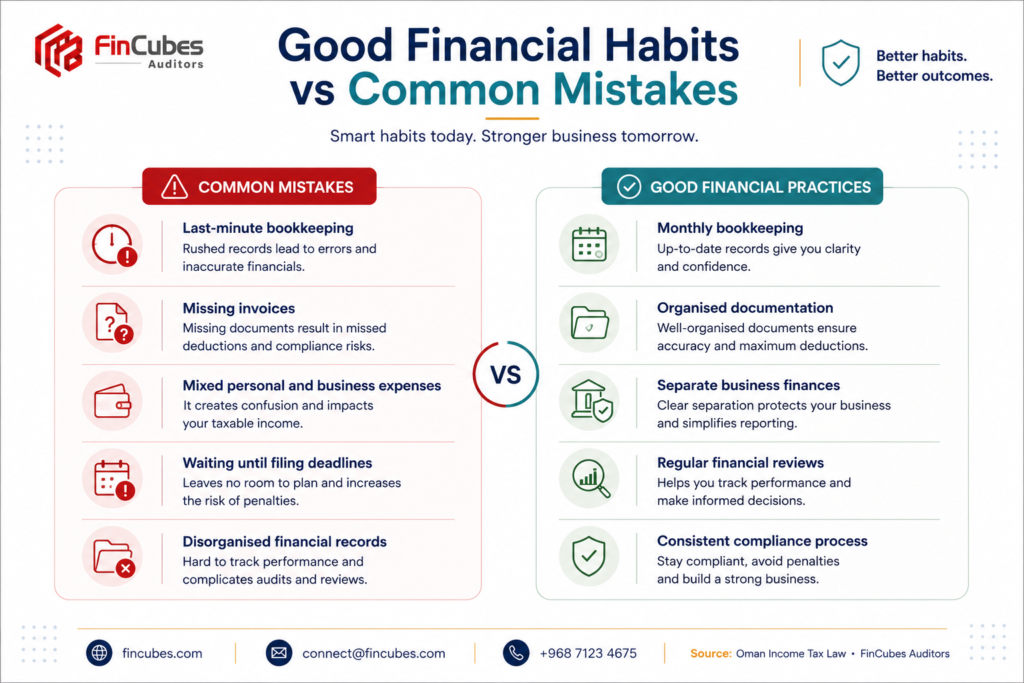
Common Corporate Tax Mistakes Businesses Make
Most Corporate Tax challenges don’t arise because businesses intentionally ignore their obligations. They often occur because financial records are incomplete, compliance responsibilities are misunderstood, or preparation begins too close to important deadlines.
Fortunately, many of these issues are preventable with good financial management and consistent processes.
Understanding the most common mistakes can help your business avoid unnecessary stress and maintain smoother compliance throughout the year.
Mistake 1- Treating Corporate Tax as a Year-End Activity
One of the most common misconceptions is that Corporate Tax only becomes relevant when it’s time to file a return.
In reality, every financial transaction recorded throughout the year contributes to your accounting records and ultimately affects your tax position.
Businesses that maintain accurate monthly bookkeeping are generally far better prepared than those trying to organise an entire year’s records shortly before filing.
💡 FinCubes Auditors Insight
The easiest Corporate Tax return to prepare is the one you’ve been preparing all year through disciplined bookkeeping and regular financial reviews.
Mistake 2 – Poor or Incomplete Bookkeeping
Bookkeeping forms the foundation of Corporate Tax compliance.
When financial records are incomplete, businesses may struggle to:
- Prepare reliable financial statements.
- Calculate taxable income accurately.
- Support figures reported in tax returns.
- Respond to requests for additional information.
Good bookkeeping is not simply an accounting function, it supports better decision-making across the entire business.
Mistake 3 – Not Keeping Supporting Documents
Every figure reported in financial statements should be supported by appropriate documentation.
Common examples include:
- Sales invoices
- Purchase invoices
- Supplier contracts
- Bank statements
- Payroll records
- Payment receipts
Missing documentation can make compliance more difficult and increase the time required to resolve financial queries.
Mistake 4 – Mixing Business and Personal Expenses
This is a common issue, particularly for smaller and growing businesses.
Using business accounts for personal expenses or vice versa can make financial reporting more complicated and create unnecessary challenges when preparing financial statements and determining taxable income.
Maintaining clear separation between business and personal finances improves both financial transparency and compliance.
Mistake 5 – Waiting Until Deadlines Approach
Businesses that postpone reviewing their financial records until filing deadlines are often forced to work under unnecessary pressure.
This can result in:
- Last-minute corrections.
- Missing documentation.
- Delayed financial reporting.
- Increased administrative workload.
Regular financial reviews throughout the year help identify and resolve issues well before compliance deadlines.
Mistake 6 – Assuming Every Business Is Treated the Same
Corporate Tax obligations depend on several factors, including the nature of the business, applicable legal provisions, and individual circumstances.
Assuming that another company’s approach automatically applies to your business can lead to incorrect decisions.
Where uncertainty exists, businesses should seek professional guidance rather than relying on assumptions.
📊 Good Practice vs Common Mistake
| Good Practice | Common Mistake |
| Update bookkeeping regularly | Update accounts only before filing deadlines |
| Keep invoices and supporting documents organised | Search for documents at year-end |
| Review financial performance periodically | Review accounts only when required |
| Separate business and personal expenses | Mix personal and business transactions |
| Plan compliance activities throughout the year | Treat Corporate Tax as a once-a-year task |
📌 Business Owner Note
Most Corporate Tax challenges begin long before a return is prepared. They usually start with small issues that accumulate over time missed reconciliations, incomplete documentation, inconsistent bookkeeping, or delayed financial reviews. Addressing these issues early is often far easier than correcting them under deadline pressure.
✅ Self-Assessment Checklist
Take a moment to evaluate your current processes.
Can you confidently answer “Yes” to the following?
- □ Our bookkeeping is updated regularly.
- □ Business and personal finances are kept separate.
- □ Supporting documents are organised and accessible.
- □ Financial statements are reviewed periodically.
- □ We understand our Corporate Tax responsibilities.
- □ We begin preparing well before compliance deadlines.
If any of these areas need improvement, strengthening your financial processes now can make future Corporate Tax compliance significantly more efficient.
Your Corporate Tax Compliance Roadmap
The Seven-Step Corporate Tax Journey
Corporate Tax compliance is not a single event, it’s a structured process that begins long before a tax return is prepared.
Businesses that follow a systematic approach generally find compliance more manageable and are better positioned to make informed financial decisions throughout the year.
The roadmap below outlines the key stages of a typical Corporate Tax compliance journey.
Step 1 – Understand Your Tax Obligations
The first step is determining whether Corporate Tax applies to your business and understanding the responsibilities that come with it.
This includes reviewing:
- Your business structure.
- The nature of your operations.
- Applicable provisions of the Income Tax Law.
- Registration requirements.
A clear understanding at the outset helps prevent confusion later in the compliance process.
Step 2 – Build a Strong Financial Foundation
Before thinking about tax returns, businesses should establish reliable financial processes.
This includes:
- Maintaining accurate bookkeeping.
- Recording transactions consistently.
- Organising supporting documents.
- Reconciling accounts regularly.
Good financial management makes every subsequent stage of Corporate Tax compliance easier.
Step 3 – Prepare Reliable Financial Statements
Financial statements provide the financial information required to understand business performance and support Corporate Tax compliance.
Preparing them regularly allows businesses to:
- Monitor profitability.
- Review financial trends.
- Identify discrepancies early.
- Make informed management decisions.
Reliable financial statements are one of the strongest indicators of a well-managed business.
Step 4 – Complete Registration Requirements
Where registration is required, businesses should complete the process with the Oman Tax Authority and ensure that all relevant business information is accurate and up to date.
Registration marks the beginning of ongoing compliance, not the end of the process.
Step 5 – Determine Taxable Income
Once financial records have been prepared, businesses can determine their taxable income in accordance with the applicable provisions of Oman’s Income Tax Law.
This stage depends heavily on the quality of the accounting information maintained throughout the year.
Businesses with organised records generally find this process significantly more straightforward.
Step 6 – Prepare and File Corporate Tax Returns
With accurate financial information available, businesses can prepare and submit their Corporate Tax returns within the prescribed timelines.
Preparing returns becomes far more efficient when bookkeeping, financial reporting, and documentation have been maintained consistently throughout the year.
Step 7 – Continue Monitoring and Improving
Corporate Tax compliance does not end once a return has been filed.
Well-managed businesses continue to:
- Review financial performance regularly.
- Maintain organised accounting records.
- Monitor regulatory developments.
- Improve internal financial processes.
- Prepare for future compliance obligations.
Continuous improvement reduces future compliance risks and supports stronger financial decision-making.
📊 Corporate Tax Compliance Journey
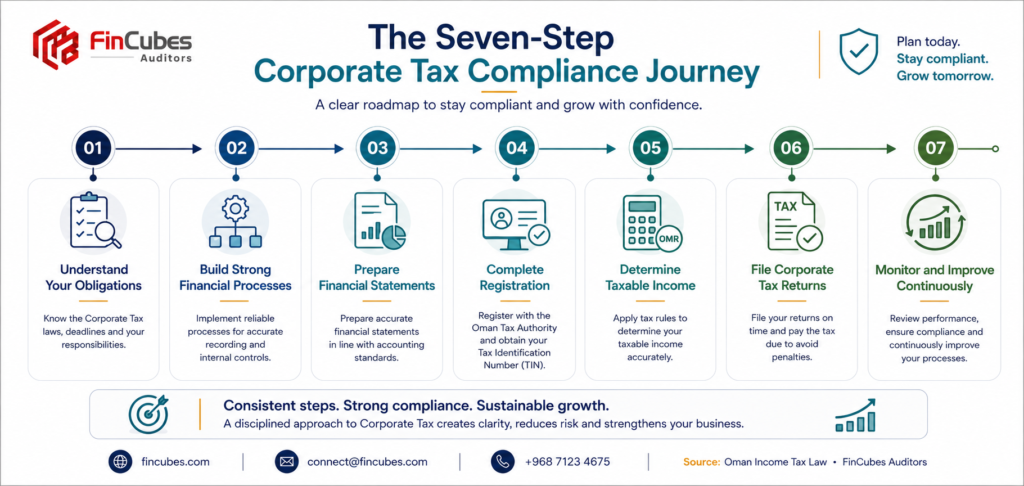
| Step | Focus | Business Objective |
| 1 | Understand your obligations | Know what applies to your business. |
| 2 | Build financial processes | Maintain accurate bookkeeping and documentation. |
| 3 | Prepare financial statements | Produce reliable financial information. |
| 4 | Complete registration | Meet applicable regulatory requirements. |
| 5 | Determine taxable income | Calculate tax using accurate financial records. |
| 6 | File Corporate Tax returns | Meet compliance obligations on time. |
| 7 | Review and improve | Strengthen financial management for future years. |
💡 FinCubes Auditors Insight
Businesses that view Corporate Tax as part of a continuous financial management cycle generally experience fewer compliance challenges than those treating it as an annual administrative task. The strongest compliance processes begin with disciplined bookkeeping, continue through regular financial reporting, and culminate in accurate tax filing. Each stage supports the next.
📌 Business Owner Note
Think of Corporate Tax as the result of good financial management, not the starting point. When bookkeeping, accounting, financial reporting, and documentation are handled consistently, Corporate Tax compliance becomes a structured process rather than a last-minute challenge.
✅ Roadmap Self-Assessment
How prepared is your business today?
- □ I understand my Corporate Tax obligations.
- □ My bookkeeping is updated regularly.
- □ Financial statements are prepared on time.
- □ Supporting documents are organised and accessible.
- □ My business has a clear compliance process.
- □ Responsibilities are assigned within the organisation.
- □ We review our financial performance throughout the year.
The more confidently you can answer “Yes” to these questions, the stronger your foundation for effective Corporate Tax compliance.
Frequently Asked Questions About Corporate Tax in Oman
1. What is Corporate Tax in Oman?
2. Is Corporate Tax calculated on revenue or profit?
Does every business operating in Oman have to pay Corporate Tax?
Why is bookkeeping important for Corporate Tax compliance?
What records should businesses maintain?
– Sales invoices
– Purchase invoices
– Bank statements
– Payroll records
– Contracts
– Payment records
– Supporting documentation for business transactions
Maintaining these records supports accurate financial reporting and future compliance.
6. How often should financial records be reviewed?
What are the most common Corporate Tax mistakes?
– They are unsure about their Corporate Tax obligations.
– Their business structure changes.
– They undertake significant transactions.
– They need assistance with financial reporting or tax compliance.
– They want to strengthen their accounting processes before filing.
Early professional guidance often helps businesses avoid unnecessary compliance challenges later.
Can accounting software help with Corporate Tax compliance?How do I get started?
When should a business seek professional advice?
– They are unsure about their Corporate Tax obligations.
– Their business structure changes.
– They undertake significant transactions.
– They need assistance with financial reporting or tax compliance.
– They want to strengthen their accounting processes before filing.
Early professional guidance often helps businesses avoid unnecessary compliance challenges later.
Where can businesses find reliable information about Corporate Tax in Oman?
💡 FinCubes Auditors Insight
The most successful businesses don’t wait until they have a tax problem before asking questions. They build a habit of understanding their financial position, reviewing compliance responsibilities regularly, and seeking guidance when uncertainty arises. This proactive approach supports better business decisions not just better tax compliance.
If You Remember Only 5 Things…
If you’ve reached this point, you now have a solid understanding of how Corporate Tax works in Oman and why it matters for businesses.
If there’s only one section you bookmark or share with your team, make it this one.
These are the five key principles every business owner should remember.
1. Corporate Tax Is Based on Taxable Income – Not Revenue
One of the most common misunderstandings is assuming that Corporate Tax is calculated on total sales or turnover.
In reality, Corporate Tax is based on taxable income, which is determined in accordance with Oman’s Income Tax Law.
Understanding the difference between revenue, profit, and taxable income is essential for accurate financial planning and compliance.
2. Good Bookkeeping Is the Foundation of Corporate Tax Compliance
Corporate Tax doesn’t begin when you prepare a return.
It begins with the quality of your bookkeeping.
Businesses that maintain accurate monthly financial records generally experience:
- Easier tax preparation.
- Better financial reporting.
- Faster access to business information.
- Fewer compliance challenges.
- More confident decision-making.
Bookkeeping is not simply an accounting function, it is the foundation that supports every stage of the Corporate Tax process.
3. Registration Is Only the Beginning
Completing your Corporate Tax registration is an important milestone, but it is only one step in the compliance journey.
Ongoing responsibilities include:
- Maintaining accounting records.
- Preparing financial statements.
- Organising supporting documentation.
- Monitoring compliance requirements.
- Filing returns within the applicable timelines.
Businesses that recognise this early are generally better prepared throughout the year.
4. Consistency Is Better Than Last-Minute Preparation
Many businesses work extremely hard just before compliance deadlines.
The businesses that experience the least stress usually do something much simpler.
They work consistently throughout the year.
Regular bookkeeping, periodic financial reviews, and organised documentation make Corporate Tax compliance significantly more manageable than trying to reconstruct an entire year’s financial activity at the last minute.
5. Corporate Tax Is Part of Good Business Management
Corporate Tax should not be viewed as an isolated compliance requirement.
It is closely connected to:
- Bookkeeping.
- Accounting.
- Financial reporting.
- Cash flow management.
- Business planning.
- Long-term growth.
Businesses that manage these areas well are generally in a stronger position to meet their compliance obligations while making better strategic decisions.
💡 FinCubes Auditors Insight
The businesses that handle Corporate Tax most effectively are rarely the ones with the largest finance teams. They are usually the businesses that have developed consistent financial habits. Good bookkeeping leads to reliable financial statements. Reliable financial statements support accurate tax calculations. Accurate tax calculations support confident compliance. Everything starts with good financial discipline.
📌 Executive Summary
If you only remember one sentence from this guide, let it be this:
Corporate Tax compliance is not a once-a-year activity, it is the outcome of consistent financial management throughout the year.
That single principle can make the difference between stressful year-end compliance and a well-organised, financially healthy business.
Conclusion
Corporate Tax is an important part of doing business in Oman, but it should not be viewed as an isolated compliance requirement or a once-a-year administrative task.
Businesses that approach Corporate Tax as part of a broader financial management strategy are generally better prepared to meet their obligations while also improving financial visibility, decision-making, and long-term business performance.
Throughout this guide, we’ve explored the key elements of Corporate Tax from understanding how the system works and determining whether it applies to your business, to maintaining accurate bookkeeping, preparing financial statements, organising supporting documentation, and building effective compliance processes.
One common theme runs through every stage:
Strong financial management makes Corporate Tax compliance significantly easier.
Businesses that invest in organised accounting records, regular financial reviews, and consistent bookkeeping often spend less time dealing with compliance issues and more time focusing on growth, profitability, and strategic decision-making.
Whether your business is newly established or has been operating in Oman for many years, reviewing your financial processes regularly can help you remain prepared for both current and future compliance requirements.
💡 FinCubes Auditors Principle
Businesses don’t become compliant because they prepare for Corporate Tax. They become compliant because they build strong financial systems throughout the year.
Corporate Tax is simply one outcome of disciplined bookkeeping, reliable accounting, organised documentation, and informed financial management.
The businesses that perform best over the long term are usually those that make financial discipline part of their everyday operations not just their year-end compliance activities.
📌 Final Thought
Corporate Tax regulations will continue to evolve as businesses and economies change.
While the legal requirements are important, the most valuable investment any business can make is building accurate financial records and reliable internal processes.
Those foundations support not only tax compliance but also stronger reporting, better cash flow management, improved decision-making, and sustainable business growth.
By approaching Corporate Tax with preparation rather than pressure, businesses can transform compliance from a regulatory obligation into an opportunity to strengthen their overall financial management.